
You are using an out of date browser. It may not display this or other websites correctly.
You should upgrade or use an alternative browser.
You should upgrade or use an alternative browser.
remote NAV radio for SkyView HDX
- Thread starter RV14_TD
- Start date

So - another solution would be - with the SV transponder, GPS (SV-GPS- 2020) and ADS-B in, using three of the five serial ports, you could install a Garmin GNC-355 as both a secondary COM transceiver AND a certified GPS navigator, and then still have one serial port left over for an N16/Vega control head, right?
Yes, although I have been told the SV-GPS-2020 does a lot that a simple position-only GPS does not do. As I understand it, many items displayed on the Skyview HDX are calculated/generated inside the SV-GPS-2020. I'm not sure if the Skyview would be able to duplicate that functionality if the 2020 was replaced with a GPS that only provides position information. Or does the GNC-355 provide the same data over it's serial interface?
You were given incorrect infromation. The SV GPS 2020 generates only position and relays the satellite time. It produces no other data. The information stream it sends is FAA IFR legal but any WAAS IFR navigator sends the same information. If you were to supply the information from the GNC-355 your screen would be exactly the same.
CanardMulti
Active Member
- Joined
- Apr 1, 2021
- Messages
- 136
One major difference: the SV-GPS-2020 (or-250) will continue to provide needed GPS data to SkyView with an airplane total electrical failure that makes SV operate from its backup battery.
I made (what I now suspect was a mistake) of purchasing the VAL Nav 2000 VOR/ILS Nav radio, which integrates with Skyview like an SL30. It works great, and I am very pleased with it, but the MGL Vega with N16 remote VHF Nav radio seems like a better option, for about the same price. I can probably sell my VAL NAV 2k for enough to make it a clean swap (or at worst, a very low price upgrade). The features I see in the Vega manual that describe it's display (in NAV All mode) make it seem very attractive. I especially like how it can display (on the VEGA) the current VOR radial, OBS Target radial, and a CDI, from the VOR dialed in the Primary frequency, as well as GS indication from an ILS in the secondary frequency. (shown below - from the Vega control manual).
Does this functionality work when MGL N16 Nav radio and Vega are installed on a serial port in Skyview HDX?This example shows a Vega display in NAV ALL mode. The display is split in a top and a bottom half. The top half is dedicated to the primary frequency and the bottom is dedicated to the secondary frequency. Primary frequency is tuned to a VOR station which is receiving a signal at -77dbm. The VOR station is flagged as valid (green background bar). The OBS has been selected to 145 degrees while we are on an outbound radial of 150 degrees. The CDI is showing that we should alter our course to the left to intercept the radial. One minor tick on the CDI scale is 1 degree, a major tick is 2 degrees. The CDI is reminding us that we have selected a FROM the VOR station course. To change FROM/TO – rotate the left rotary control to the appropriate OBS course.Note that the RADial readout changes from RAD to BRG if you select a OBS course TO the station. The bottom half of the display shows that we have tuned to a localizer frequency (ILS). In this case we are receiving the glide slope at -92dbm but it is still flagged as not valid. It is however already showing on the needles display but has been given a yellow caution color. The localizer is receiving at -81dbm and is not flagged (green bar as background). The needles display shows the localizer in blue. In this case we are to the right of the runway centerline and below the glide slope. This is a typical image you might see on initial approach to a runway.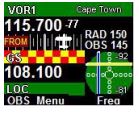
Last edited:
CanardMulti
Active Member
- Joined
- Apr 1, 2021
- Messages
- 136
The NAVALL mode you have shown displays the Vega in SCAN mode. I've not had the opportunity to test this mode with VOR as the primary frequency and an ILS in the secondary frequency, but I have played with two VOR frequencies. The depicted radial for the primary frequency on the N16 can be shown as the SV HSI's bearing pointer and (if selected as the nav source) the OBS will set the desired course on the HSI. Whether it is SV pointer #1 or #2 depends on how you have named your NAV radios. In my case I've got my N16 as NAV 1 (N16 > MGL CANBUS > Vega > RS232 SL30 emulation > SV serial port) and my Avidyne IFD 540's VHF NAV as NAV 2 (IFD 540 > ARINC bus > SV-ARINC-429 > Dynon network > SkyView).Does this functionality work when MGL N16 Nav radio and Vega are installed on a serial port in Skyview HDX?
This is really getting down into the weeds here, but SV bearing pointers supposedly have the capability to depict the NAV 1 standby radial (in SV speak, secondary frequency radial in Vega speak) as a bearing pointer, but I've yet to discover how to get that to work. This dovetails into your question: other than that standby radial, no other secondary frequency related information is sent from the Vega to SkyView. If what I suspect you are looking to do is to fly a specific VOR radial in order to intercept an ILS final, you would need to flip flop the example picture's frequencies to send the ILS info to SV's HSI as soon as the REALLY tiny localizer display on the Vega became active, in order to complete the intercept on SV.
Now to go even deeper into the weeds. Just one problem with the above scenario: even though it would work, it's technically not 'legal' to use your N16 as a primary IFR nav source if it's in the SCAN mode because both the letter ID and aural identifiers are only available with the SCAN mode OFF. With SCAN active the radio continually switches frequencies rapidly back and fourth, too fast to pick up an identifier that's transmitted at human hearing speeds. In the OFF mode, the bottom frequency becomes grayed out and is just a standby frequency display. The radio listens to the primary identifier, decodes it, and puts the identifier's letters on the screen. The aural identifier also becomes available for us 'old school' types.
The phrase 'Tune, Identify, Monitor' may be faintly remembered by some from their instrument training days, but I'd bet a fair number of folks skip the Identify part if the radial looks right, and precious few actually continually Monitor the aural identifier (even low in the background) as is technically required. Many modern systems, N16 included, have the ability to listen to the aural identifier and decode it for the pilot, and having the letters of the ID on your PFD also satisfies the Monitor requirement. Recall that a VOR display that appears correct is still not legal to use unless the aural identifier is also good, since one of the methods used by electronics techs to indicate the signal may be inaccurate during maintenance is to remove the aural identifier, leaving nothing to decode for the PFD.
Well, much information there. Thanks!
I was assuming that the Skyview could only display data from the primary frequency. I was assuming that the N16 had two receivers, one for primary freq and one for the Standby. I guess I should have understood the way it really works from the word "Scan". Funny, but we had an anti-jamming UHF Com radio in the service that did something similar, switching frequencies very rapidly,, in a synchronized, time coordinated way, to counter enemy jamming.
Anyway what I was really asking was if the Vega can still be set up to display data from both frequencies, on the Vega display, as shown, when it is hooked up to Skyview HDX. From your reply, I take it that the answer is yes. Although I have now learned from your post that to do this, you have to put the N16 in Scan mode, and that then it is not legal to use IFR.
In the manual, it says that to display data from both frequencies on the Vega requires that the N16 be in NAV All. Is that the same as Scan mode?
Is that accurate?
I was assuming that the Skyview could only display data from the primary frequency. I was assuming that the N16 had two receivers, one for primary freq and one for the Standby. I guess I should have understood the way it really works from the word "Scan". Funny, but we had an anti-jamming UHF Com radio in the service that did something similar, switching frequencies very rapidly,, in a synchronized, time coordinated way, to counter enemy jamming.
Anyway what I was really asking was if the Vega can still be set up to display data from both frequencies, on the Vega display, as shown, when it is hooked up to Skyview HDX. From your reply, I take it that the answer is yes. Although I have now learned from your post that to do this, you have to put the N16 in Scan mode, and that then it is not legal to use IFR.
In the manual, it says that to display data from both frequencies on the Vega requires that the N16 be in NAV All. Is that the same as Scan mode?
Is that accurate?
Last edited:
CanardMulti
Active Member
- Joined
- Apr 1, 2021
- Messages
- 136
Been there, done that, re using UHF frequency hopping. 'Nuff saidWell, much information there. Thanks!
I was assuming that the Skyview could only display data from the primary frequency. I was assuming that the N16 had two receivers, one for primary freq and one for the Standby. I guess I should have understood the way it really works from the word "Scan". Funny, but we had an anti-jamming UHF Com radio in the service that did something similar, switching frequencies very rapidly,, in a synchronized, time coordinated way, to counter enemy jamming.
Anyway what I was really asking was if the Vega can still be set up to display data from both frequencies, on the Vega display, as shown, when it is hooked up to Skyview HDX. From your reply, I take it that the answer is yes. Although I have now learned from your post that to do this, you have to put the N16 in Scan mode, and that then it is not legal to use IFR.
In the manual, it says that to display data from both frequencies on the Vega requires that the N16 be in NAV All. Is that the same as Scan mode?
Is that accurate?
 .
.Re your scan all question: Not precisely. In NAV ALL mode, both the primary and secondary frequencies are displayed, w/ primary top & secondary bottom. There are 2 sub-modes in NAV ALL. In the SCAN ALL sub-mode of NAV ALL, both frequencies are displayed in color and actively tuned via the previously mentioned frequency hopping, and the data from both as displayed on your Vega "should" be accurate. In the SCAN OFF sub-mode of NAV ALL mode, the primary frequency is the only one actively tuned and its letter ID is displayed on the upper half of the Vega display, while the secondary frequency is only displayed below as the (pilot) tuned flip-flop frequency on the bottom half.
Clear as mud, right?
Ken
Ken, yes, actually, it is (perfectly clear). And, as I read the Vega manual, you can quickly toggle the Scan on and off, which means you could put the more significant frequency, (the one you are currently using for IFR navigation, like the ILS on an approach), in primary and the less important one, (like the airfield VOR), in Standby, and set Scan OFF to verify the ident, then set it On to monitor the VOR radial for the rest of the approach.
CanardMulti
Active Member
- Joined
- Apr 1, 2021
- Messages
- 136
Correct up until the last part of the last sentence. Remember, whenever SCAN is *ON*, there is no way to continually Monitor the ID of the radio nav aid in use, neither the primary nor the secondary. In the real world I suspect many folks would do pretty much what you propose and ignore the monitor requirement.
Ken
Ken
But is it legally (FAA legal), required to be continuously monitoring the ident? I mean if you check and validate the ident with SCAN off on the primary frequency, (the one you're using to navigate, say an ILS), then can't you then turn SCAN on to monitor the standby freq and still be legal?
Interpreting the rule the way you seem to would imply that it would be illegal to even turn down the volume, no?....
Interpreting the rule the way you seem to would imply that it would be illegal to even turn down the volume, no?....
Marc_J._Zeitlin
Active Member
Can you point me to the FAR that requires this, please? I do not recall this from my training. Thanks.The phrase 'Tune, Identify, Monitor' may be faintly remembered by some from their instrument training days, but I'd bet a fair number of folks skip the Identify part if the radial looks right, and precious few actually continually Monitor the aural identifier (even low in the background) as is technically required.
CanardMulti
Active Member
- Joined
- Apr 1, 2021
- Messages
- 136
Hi Marc-Can you point me to the FAR that requires this, please? I do not recall this from my training. Thanks.
As to whether or not it was taught just might be an indicator of where the CFII received his initial IFR training, civilian or military.
The AIM and the various handbooks published by the FAA all explicitly require the tune and identify portion. Not far from those requirements are stated will usually be a notation to the effect that VORs can radiate an inaccurate signal while undergoing maintenance in which case the ID is either removed or the ID letters "TEST" are transmitted. To some instructors, that implies a requirement to monitor. To others, it does not. This seems to be all the civilian manuals have to say on the subject making it appear a squishy requirement at best and a matter of opinion.
The military doesn't do squishy. AFMAN 11-217 and its predecessor AFM 51-37 have been the absolute Bible of USAF instrument flying for well over half a century. From the most recent 11-217 I could find:
Pretty cut and dried.
Ken
Marc_J._Zeitlin
Active Member
Ken - you realize that the AIM and handbooks are (while very good advice) NOT regulatory, right? If it's not in a FAR, it's not a rule, it's a recommendation. I certainly agree that it's a good idea to know whether or not the VOR you've tuned in is the one you THINK it is, but there is (to my knowledge) no FAR that requires you constantly monitor it to make sure they haven't changed anything in the 5 minutes since you first tuned it in.The AIM and the various handbooks published by the FAA all explicitly require the tune and identify portion. Not far from those requirements are stated will usually be a notation to the effect that VORs can radiate an inaccurate signal while undergoing maintenance in which case the ID is either removed or the ID letters "TEST" are transmitted. To some instructors, that implies a requirement to monitor. To others, it does not. This seems to be all the civilian manuals have to say on the subject making it appear a squishy requirement at best and a matter of opinion.
What the military does or does not do, from a rules standpoint, is completely immaterial in the civilian world.
Marc,
Yes, although, (putting the legality aside for the moment), the logic is pretty compelling. To my original question, I think it is pretty clear that in addition to checking the ident before commencing an approach, we should monitor it, at a minimum, often enough to be sure the signal is reliable.
I think a wise practice would be, whenever possible, try to use some other navigational source, (GPS, another VOR, etc.), to at least give me a warning when I am getting grossly inconsistent information from the two sources. Any indication that the signal is not consistent should be a warning to check the ident again, (or go missed). Modern glass map displays are a great tool to do that. On a VOR, LOC or ILS approach, monitoring displayed GPS position over a depicted approach plate provides a welcome warm fuzzy.
Charly
Yes, although, (putting the legality aside for the moment), the logic is pretty compelling. To my original question, I think it is pretty clear that in addition to checking the ident before commencing an approach, we should monitor it, at a minimum, often enough to be sure the signal is reliable.
I think a wise practice would be, whenever possible, try to use some other navigational source, (GPS, another VOR, etc.), to at least give me a warning when I am getting grossly inconsistent information from the two sources. Any indication that the signal is not consistent should be a warning to check the ident again, (or go missed). Modern glass map displays are a great tool to do that. On a VOR, LOC or ILS approach, monitoring displayed GPS position over a depicted approach plate provides a welcome warm fuzzy.
Charly